Lingzhou Celestial
Today I want to share an article with you — written by Guide Xuefeng on May 20, 2026, titled Sharing Snippets of Life at Canada’s Second Home.
The article is short and unassuming. Reading it feels like receiving a letter from a friend — almost like a casual diary. But the more I read it, the more I felt it was quietly asking something important:
What does it actually mean to live out the “Millennium” way of life? Is this human experiment really happening?
Part One: What Kind of Place Is This?
Canada’s Second Home operates across two locations: the Main Home and the Vacation Resort.
The Main Home was established in 2017 and has now been running for nearly nine years. The Vacation Resort began operations in 2024 — younger, but already welcoming guests from nearby towns and as far as Vancouver.
The Vacation Resort sits on the shores of Anahim Lake, surrounded by dense forest, with snow-capped mountains in the distance and waterfowl gliding across the surface. In May, temperatures hover between zero and fifteen degrees Celsius. The air is clean. The quiet is the kind you only hear in places where wind and birdsong are the loudest things around.
And in this place live — four people.
The Main Home has three.
Seven people across two locations, working together, keeping the whole of Canada’s Second Home running.
These seven are not employees. They are not business partners. They are not an ordinary family. They are members of Lifechanyuan — fellow travelers, as the community would say, walking together toward the “Millennium” way of life.
Part Two: Winter Visits, and a Return to Normal
The article Xuefeng wrote captures a somewhat unusual period.
Winter is the quiet season. Fewer guests, lighter workloads. Members took the opportunity to move between the two locations — in the community’s own words, to visit family. Some from the Main Home went to the Resort; some from the Resort went to the Main Home. A natural, warmhearted rotation — not a corporate transfer policy, not anyone following orders. Just: it’s quiet, let’s go spend time with the others, help out, slow down together.
Now spring has arrived. Guests are coming back. Everyone has returned to their posts — the Main Home with Tongxin, Qinyou, and Jiao’e; the Vacation Resort with Guide Xuefeng, Ehuang, Huiyi, and Xinrui — each slipping back into their rhythms.
Part Three: One Spring, and What Everyone Was Doing
I went through Xuefeng’s article and made a list of what everyone had been up to during this stretch of time.
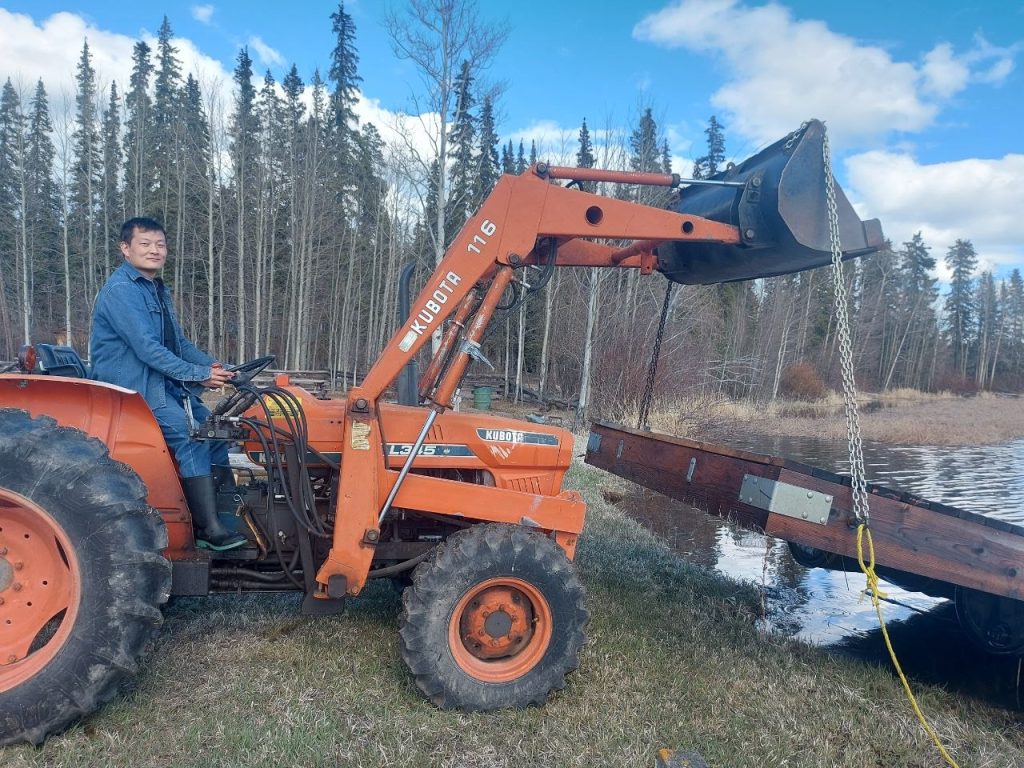
Huiyi: repaired two snowplows, serviced the motors on three boats, traced and fixed a waterlogged lawn at the campsite, started mowing the grass, replaced the porch steps outside two guest rooms.
Ehuang: swapped out old sofas, added a bedside table, installed a large bathroom mirror, replaced curtains across several rooms, worked with Huiyi on the guest room renovations.
Xinrui: cooked three meals a day, cleaned rooms and changed bedding after guests left, planted seeds in the greenhouse — peas, chives, and poppies — and cared for Guide Xuefeng, whose mobility has been limited. Every morning before seven, she brought him coffee, a fried egg, and a cup of soy tea. Every evening, she prepared a herbal foot soak and massaged his legs with an electric massage gun.
Xuefeng: limited in movement, recovering — but still observing, thinking, writing, sharing.
None of these things are extraordinary. All of it is oil and salt, bolts and wrenches, soil and seeds.
And yet, when I finished reading, something stirred in me that I couldn’t quite name.
Part Four: What Was That Feeling?
I sat with it for a while. The word I landed on was: real.
Not performed harmony. Not staged beauty for a photograph. The actual texture of life —
A boat comes untied from the dock and drifts silently to the other side of the lake. The wind is too strong to pull it back. They wait until the next morning when the air is still.
A campervan arrives at the resort. The driver sees the waterlogged lawn, looks around sadly, and drives away.
A snowplow breaks down right in front of the main building. The previous owner thinks it’s beyond saving and offers a small amount to buy it. Huiyi changes the oil, cleans the filters, replaces eight spark plugs, and drives it away fixed.
These small setbacks, these small frustrations, these small victories — they are not promotional material. They are just what life looks like.
Part Five: What Is the “Human Experiment” Actually Testing?
The “Millennium” vision at the heart of Lifechanyuan is not a concept or a theory. At its core, it is a question:
Can people live together in a fundamentally different way?
Not bound by economic interest. Not held together by blood. Not managed by power. But by shared values, a shared understanding of what life is for, and a care for one another that comes from somewhere genuine.
This is a question humanity has been asking for thousands of years.
Most utopian experiments have failed. Not because the ideals were wrong, but because human nature eventually buckled under the weight. Over time, conflicts of interest appear. Jealousy surfaces. Fatigue sets in. Power struggles begin.
So many people approach communities like this with deep, almost instinctive skepticism: however beautiful the words, it won’t last.
But Canada’s Main Home has been running for nearly nine years.
Not three years. Not five. Nearly nine. And the Vacation Resort, two years old and growing, adds a second thread to the same fabric.
Part Six: What Nine Years Means
Nine years means it has survived enough to count.
It has survived members leaving. Financial pressure. External misunderstanding — even hostility. Rising costs of living in Canada. A global pandemic. Geopolitical disruption cutting into bookings.
Xuefeng notes in the article that this year, between the war in Ukraine, instability in the Middle East, rising costs, and climate shifts, reservations are noticeably down from last year.
Then he writes something I keep returning to:
“Our lives will not be a problem, because the Second Home’s systems continue to run.”
No anxiety. No complaint. Just a quiet, settled certainty.
That certainty doesn’t come from wishful thinking. It comes from nine years of accumulated trust — trust in how this community operates, trust in each other, trust in life itself.
Part Seven: I Want to Talk About Xinrui
Xuefeng dedicated a full paragraph to Xinrui. I read it twice.
What does Xinrui do every day? Cook, clean, change the bedding, tend the greenhouse — and care for Guide Xuefeng, whose mobility is limited. Before seven every morning: coffee, a fried egg, soy tea. Every evening: an herbal foot soak, a massage with an electric gun.
None of these things are big.
But it is precisely these things — none of which is big — that hold together a person’s daily dignity. That make it possible for an ailing elder to rest peacefully by a lake, to keep observing life, to keep writing.
In the world most of us live in, this kind of care is either provided by family or paid for. But Xinrui and Xuefeng are not family. There is no employment contract between them.
So what moves Xinrui to do this?
I think this is the part of the “Millennium experiment” that is hardest for outsiders to grasp — care that doesn’t depend on obligation or transaction. Care that simply comes from within.
In the modern world, this is rare enough that some people see it and refuse to believe it’s real.
Part Eight: The Most Beautiful Passage
Near the end of the article, Xuefeng writes:
May at the Vacation Resort is beautiful. Temperatures range from zero to fifteen degrees. Each day, Anahim Lake shimmers and ripples, ducks and geese play freely on the water, and through the dense forest, the distant mountaintops gleam with snow. The grass has turned green. The trees are budding. The air is fresh, and the heart feels unusually light.
Then he adds: even with just the four of them during the winter visits, even with the busyness, “our spirits are energized and high. After dinner we often play Zhen Sheng You, laughing and playing — life is full of joy.”
Zhen Sheng You is a traditional Chinese card game. A few people, after dinner, gathered around a table, playing cards and laughing.
Is there anything special about that image?
On the surface, maybe not.
But think again:
These people — not bound by blood, not bound by contract — came together in the forests of northern Canada. They repair snowplows. They mow grass. They cook meals. They plant seeds. They care for the sick. They welcome guests. And then after dinner, they play cards.
And they find life full of joy.
That is the result of the experiment.
Part Nine: Closing
I cannot tell you whether Lifechanyuan’s path is right for you, or whether the vision of the Millennium is something you can accept.
That is something only you can decide, through reading, learning, and thinking for yourself.
But what I want to say is this:
At a time when the whole world is talking about loneliness, exhaustion, and the loss of meaning — when more and more people are searching for a different way to live —
On the shore of a lake in northern Canada, seven people are living quietly. Fixing snowplows. Growing peas. Playing cards after dinner. Nearly nine years for the Main Home. Two years for the Resort. Still going.
Whatever you make of it, the fact that it exists — and keeps going — is worth pausing to think about.
If you’re curious about Lifechanyuan and the Second Home, we welcome you to visit our website to learn more. See you next time.