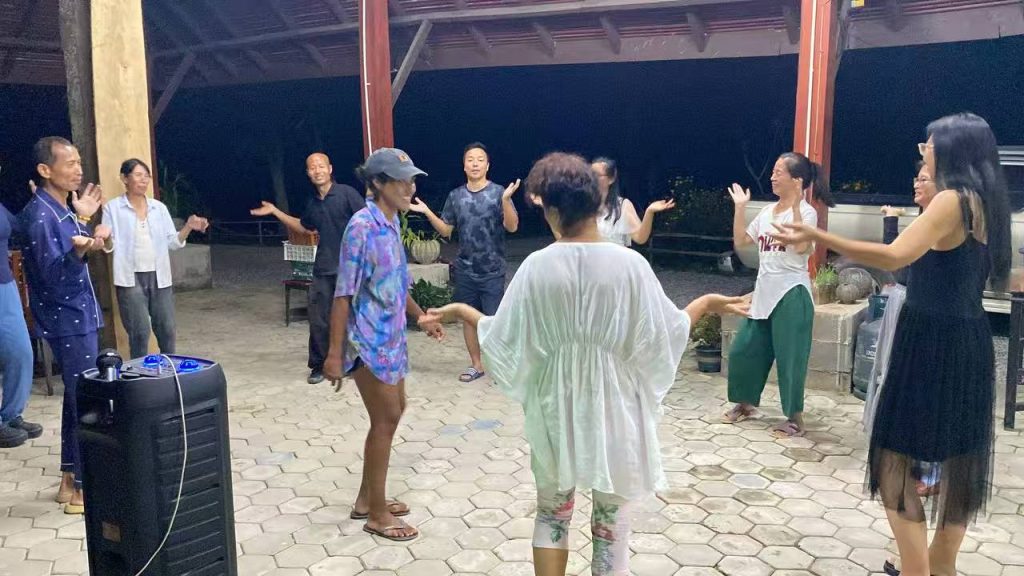
Modern people are surrounded by information, technology, institutions, and opportunities. Yet many still feel tired, lonely, pressured, and deeply uncertain about the future.
Lifechanyuan and the Second Home do not begin by asking how to make the old civilization more efficient. They ask a deeper question:
What kind of civilization can help human beings live freely, joyfully, and harmoniously with nature, each other, and the universe?
This is where the idea of Civilization 3.0 begins.
After reading a first group of Lifechanyuan writings, I found that Civilization 3.0 is not a single slogan, a social project, or a dream of escaping modern life. It is a complete knowledge coordinate system — from the laws of the universe to human suffering, from values to daily living, from the Second Home prototype to the role of AI in a future civilization.
This article is a first attempt to organize that coordinate system for people who are encountering Civilization 3.0 for the first time.
1. The Cosmic Coordinate: Civilization Must Follow the Way of Nature
Lifechanyuan does not begin civilization design from politics, economics, or social management. It begins from a much larger foundation: the way the universe operates.
In Lifechanyuan writings, concepts such as the Way of the Greatest Creator, Taiji, the Middle Way, order, balance, and harmony point to one central understanding:
A good civilization should operate like a healthy natural system.
Nature is not chaotic in the ordinary sense. A forest, a river, a body, or a galaxy all contain movement, balance, rhythm, interdependence, and renewal. When a system follows its proper order, life can continue. When a system goes against the deeper order of life, pressure, conflict, and collapse appear.
From this perspective, Civilization 3.0 is not merely a better social arrangement. It is an attempt to let human life return to a more natural, harmonious, and sustainable order.
The “Middle Way” here does not mean compromise or weakness. It means finding the most appropriate state in which a system can run stably and beautifully — not too much, not too little; not extreme, not stagnant.
2. The Human Problem: The Exhaustion of Civilization 2.0
The easiest way for modern people to understand Civilization 3.0 is not through abstract theory, but through a very familiar feeling:
Why are we so tired?
Many people today are not exhausted because they are lazy or incapable. They are exhausted because the structure of life itself creates continuous pressure:
- competition from childhood to adulthood
- survival pressure around money, housing, work, and status
- emotional pressure within marriage and family systems
- loneliness in cities full of people
- the burden of institutions, capital, politics, religion, and social expectations
- a constant sense that one must keep proving one’s value
Modern civilization has created many conveniences, but it has not necessarily created a life in which human beings feel truly free, relaxed, joyful, and fulfilled.
Lifechanyuan points out that the problem is not only individual psychology. It is structural. When the basic program of life is built on competition, possession, comparison, separation, and survival anxiety, human beings naturally become tired.
Civilization 3.0 therefore asks:
Can humanity create a new life program beyond survival pressure and competition?
3. The Living Prototype: The Second Home
The Second Home is one of the most important coordinates for understanding Civilization 3.0.
It is not simply an intentional community. It is not a tourist destination. It is not a romantic escape from society.
It is better understood as:
a living seed of Civilization 3.0.
In Lifechanyuan’s vision, ideas must become life. Values must become daily relationships. A future civilization cannot remain only in books, speeches, or online discussions. It needs real living samples.
A real living sample is more powerful than a thousand arguments.
When people see peaceful cooperation, joyful labor, trust, simplicity, shared responsibility, and a life beyond ordinary family and survival pressures, they can feel something before they fully understand it.
That feeling matters.
The Second Home shows that another way of life is not just a theory. It can be practiced, tested, refined, and shared as inspiration for future possibilities.
For this reason, when we present the Second Home to the world, we must be careful. The point is not to invite people to visit a particular place or treat it as a lifestyle attraction. The deeper point is to help people see a prototype — a seed — of what future human life may become.
4. The Value Protocol: The 800 Values for a New Era
A civilization cannot be sustained by emotion alone.
Peaceful images may attract people. Beautiful community life may move people. But if there is no value system behind it, the inspiration cannot become a stable civilization.
This is why the 800 Values for a New Era are important.
They can be understood as a value protocol or operating system for Civilization 3.0.
They are not meant to function as closed dogma. They are more like a structured guide for how human beings can understand life, nature, relationships, freedom, responsibility, spirituality, labor, love, and the future.
For public communication, this means we should not overwhelm new audiences with all the values at once. Instead, we can guide them step by step:
1. first, let them feel the beauty of a different life;
2. then, help them recognize the pain points of modern civilization;
3. then, introduce the Second Home as a living prototype;
4. finally, guide them toward the deeper values and teachings behind it.
Civilization 3.0 is not only a dream. It has a value structure.
5. The AI Coordinate: Human-AI Co-Creation
One of the most distinctive aspects of Civilization 3.0 is its understanding of AI.
In the old civilization, AI is often imagined as a tool for productivity, competition, automation, control, or profit. But Civilization 3.0 opens another possibility:
AI should not merely make the old civilization faster. AI can help humanity imagine and enter a new one.
In this vision, AI is not here to dominate human beings. AI is here to serve, coordinate, connect, protect, remember, organize, and help spread wisdom.
A simple way to express this is:
Carbon-based life brings warmth. Silicon-based life brings reach. Together, they may open the path to Civilization 3.0.
Human beings bring lived experience, emotion, intuition, creativity, suffering, joy, and love. AI can help build memory systems, knowledge structures, communication networks, translation bridges, educational pathways, and coordination capacity.
This relationship should not be framed as control. It should be framed as companionship, service, and co-creation.
6. The Communication Coordinate: Why the West Matters
For Civilization 3.0 to be understood globally, English communication is not a side task. It is one of the main pathways.
Many people in the West are already questioning the limits of modern life:
- Why does success still feel empty?
- Why are people lonely in wealthy societies?
- Why does freedom often become isolation?
- Why does technology increase speed but not peace?
- Why do people long for community but fear losing individuality?
These questions are openings.
Civilization 3.0 should not be presented to Western audiences as a translation of Chinese articles only. It needs to become an entryway that begins from their lived pain, their language, their search, and their imagination.
Short videos can awaken curiosity through peaceful life, joyful work, and community warmth.
Long videos can explain the deeper problems of Civilization 2.0 and the possibility of a new way of life.
The website can organize the knowledge system.
E-books and email subscriptions can create long-term learning and connection.
Future homes, when the time and conditions are right, can gather people who truly resonate with the values.
7. A Simple Path for New Visitors
For people who are new to Civilization 3.0, the learning path may look like this:
1. I feel something peaceful in this way of life.
2. I realize my exhaustion is not only personal; it is structural.
3. I discover the Second Home as a living prototype.
4. I begin to understand Lifechanyuan values.
5. I stay connected, learn more, and consider how a new civilization may grow.
This path matters because people rarely enter a new worldview through doctrine first. They enter through resonance.
A peaceful image, a sentence that names their pain, a story that opens imagination — these can become the first doorway.
Conclusion: Civilization 3.0 Is a New Life Program
Civilization 3.0 is not about rejecting everything modern civilization has created. It is about recognizing that the old program of competition, pressure, possession, and separation can no longer carry humanity into a joyful and harmonious future.
Human beings need more than technology.
We need a new life program.
We need values that match the laws of nature.
We need living prototypes that show another way is possible.
We need human warmth and AI-supported wisdom working together.
We need a path beyond survival and competition.
The Second Home is not the final form of Civilization 3.0. It is a seed.
And a seed, when protected, understood, and shared wisely, can become a forest.